
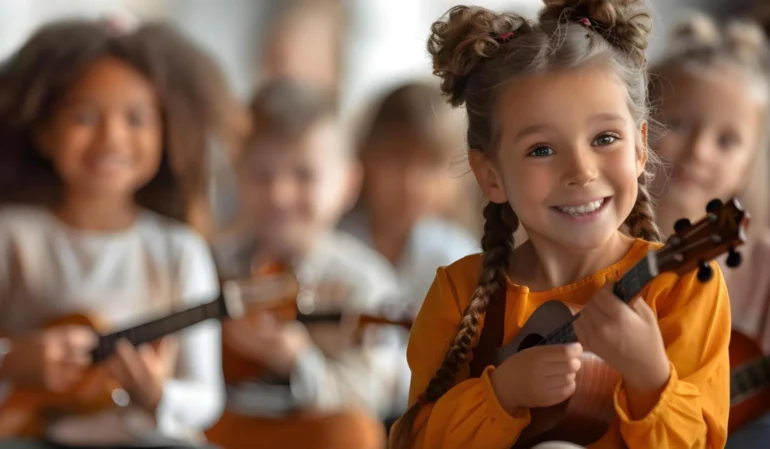
Music for child development is more than just entertainment — it’s a powerful tool that supports your child’s growth in many important ways. From building brain connections to improving social and emotional skills, music plays a vital role in early childhood development. Here are five ways music helps your little one thrive and support their child development, along with some fun ways to incorporate music into their daily life.
1. Boosts Brain Development in Children
Listening to and playing music stimulates multiple areas of the brain simultaneously. It strengthens neural pathways that support memory, problem-solving, and creativity. Studies show that children who are exposed to music early often perform better in subjects like math and reading because rhythm and pattern recognition enhance logical thinking and concentration. Child development experts highlight the connection between early musical experiences and improved academic performance.
For example, children who practice playing instruments may show increased cognitive skills in areas like math, due to the mathematical properties of rhythm and timing. Music also promotes memory retention, as children associate different sounds, rhythms, and melodies with actions or words.
2. Improves Language and Communication Skills Through Music
Music introduces children to new sounds, words, and rhythms, which helps develop language skills. Singing nursery rhymes and songs builds vocabulary and pronunciation, while listening to lyrics improves comprehension. Repetitive songs also make it easier for kids to remember new words and sentence structures naturally. Child development research shows that music plays an essential role in building early language skills.
For example, songs like “Twinkle, Twinkle, Little Star” or “The Wheels on the Bus” introduce children to simple rhymes and repetitive structures that help them grasp language more effectively. Singing along with these songs helps kids learn the rhythm of speech and improves their ability to form sentences.
3. Enhances Motor Skills and Coordination
Dancing, clapping, and playing simple instruments like tambourines or maracas improve fine and gross motor skills. These musical movements help children develop better hand-eye coordination, timing, and balance. Even toddlers who sway or tap along to music are building essential motor connections in their brains. These activities are not only fun but also aid in their child development in critical areas such as motor coordination.
Activities like dancing to the beat or playing rhythm instruments encourage children to synchronize their movements with the tempo of the music, thus improving their physical coordination. These activities help them develop gross motor skills (larger movements like running or jumping) as well as fine motor skills (smaller movements like finger movements while playing instruments).
4. Encourages Emotional Expression Through Music
Music gives children a safe and joyful way to express feelings they might not yet have words for. Whether it’s singing a happy tune or listening to a calming lullaby, music helps them process emotions, build self-awareness, and develop empathy. It can also reduce stress and anxiety, making it a great tool for emotional regulation. Understanding child development through music allows children to manage emotions more effectively.
For example, children may sing along to an upbeat song when they feel excited, or a slow, soothing lullaby to calm down before bed. This allows children to express their emotions and understand how music can reflect feelings. Music can help them learn how to control their emotions and develop emotional intelligence.
5. Fosters Social and Creative Skills
Group music activities, like singing in a circle or playing instruments together, encourage teamwork and cooperation. Kids learn to listen, take turns, and share — all essential social skills. At the same time, music inspires creativity, imagination, and confidence as children explore different sounds and express themselves freely. Music also nurtures creative thinking, which is an essential component of child development.
Playing in a group or family band teaches children the importance of working together. They learn that music is about more than just individual expression; it’s also about cooperation and sharing the spotlight. Group singing or playing instruments helps children understand how to harmonize with others, take turns, and communicate without words.
Conclusion: Nurturing Child Development with Music
5 Transformative Benefits of Child Development Through Music
Incorporating music into your child’s daily routine doesn’t require special training or expensive instruments. Sing together, play background music, dance, or make your own instruments at home! Every note helps nurture their cognitive, emotional, and social development — while creating joyful memories along the way.
Music is an affordable, enjoyable, and powerful way to support your child’s growth. Start introducing simple songs and musical activities today, and watch as your little one blossoms with new skills and emotional awareness!